
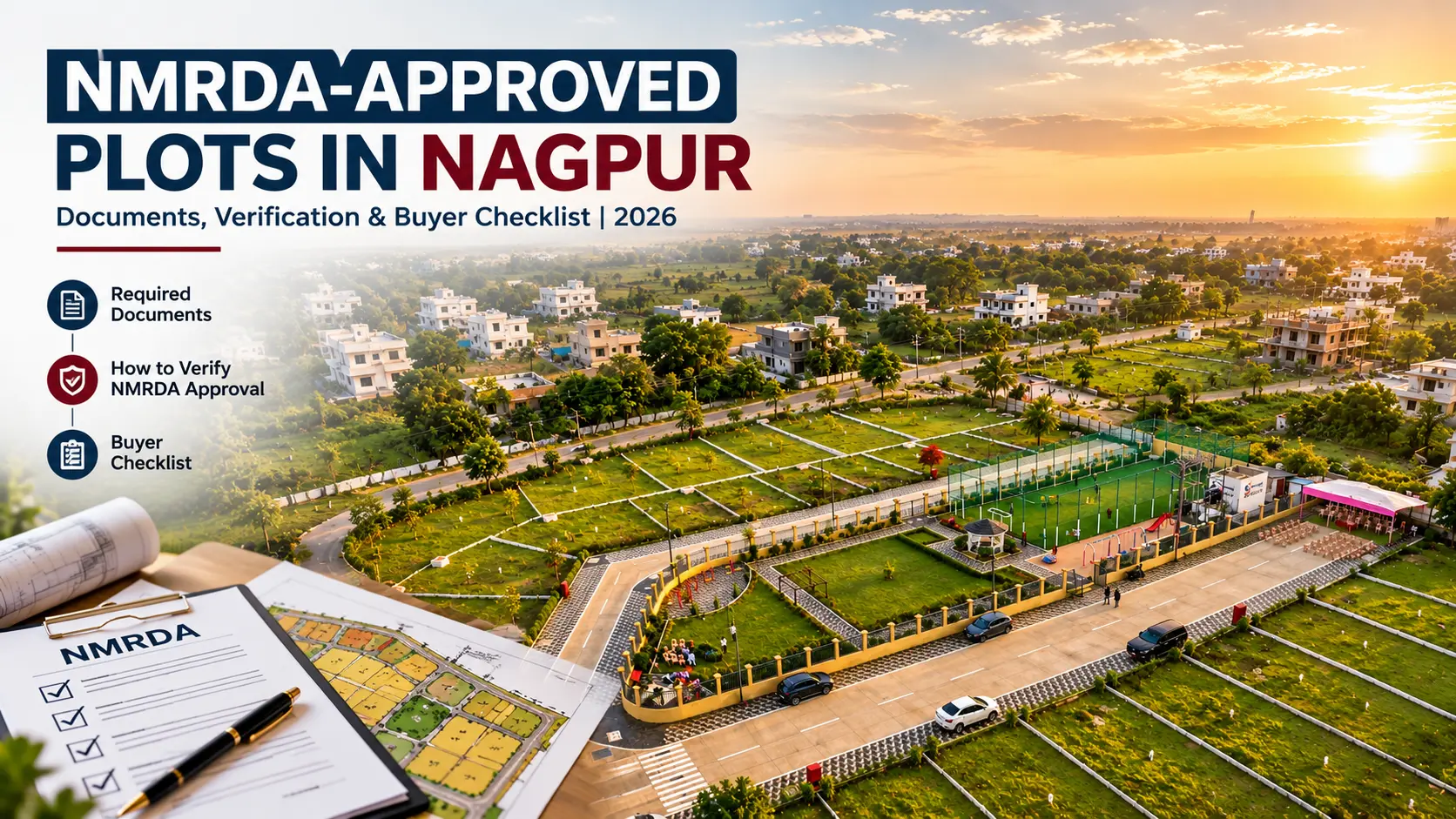
Buying a residential plot is an important financial decision, whether you are planning to build your dream home, purchase land for your family or explore long-term property investment. With residential development expanding across different parts of Nagpur, many buyers search online for NMRDA-approved plots in Nagpur, NMRDA plots in Nagpur, residential plots in Nagpur and plots for sale in Nagpur. However, finding an attractive plot at the right price is only one part of the buying process. Before booking any property, you need to understand its legal status, sanctioned layout, land-use permissions, ownership records and applicable development approvals.
For buyers exploring the Nagpur real estate market, checking whether a plot is approved by the relevant planning authority is an essential part of due diligence. The Nagpur Metropolitan Region Development Authority (NMRDA) publishes official planning resources, including approved-layout information and layout-related forms, which buyers can consult when verifying properties that fall within its jurisdiction. However, not every property around Nagpur necessarily falls under NMRDA, so the competent authority for the exact location must be identified first.
This guide explains how to verify NMRDA-approved plots in Nagpur, which documents to request, how NMRDA approval differs from MahaRERA registration, and what to check before making a payment. It also explains how to compare residential plotted developments in locations such as MIHAN, Wardha Road, Jamtha and Chicholi without relying only on advertisements or future appreciation claims.
NMRDA-approved plots generally refers to plots within a layout or development that has received the relevant approval from the Nagpur Metropolitan Region Development Authority, where NMRDA is the competent authority. Such approval relates to the sanctioned development or layout and should be verified against the actual project documents and official records. Buyers should not assume that a plot is approved simply because a property advertisement, salesperson or brochure uses the words “NMRDA approved.”
The first step is to confirm the property's exact location, survey or khasra details, layout name and the authority responsible for planning permission. Depending on where the land is situated, the competent authority may differ. A property marketed as being near Nagpur, MIHAN or Wardha Road does not automatically come under the same approval jurisdiction as every other property in that broader area.
Buyers searching for NMRDA-approved plots in Nagpur should ask the seller or developer for the sanctioned layout plan, approval letter and any applicable release or development-permission documents. Compare these records with the actual plot being offered. The plot number, boundaries, survey details and layout configuration should be consistent across the documents provided. If the information does not match, seek clarification and independent legal advice before proceeding.
For official reference, visit the NMRDA website and its downloads and planning documents section, which includes approved-layout information and relevant forms.
Verifying plot approval helps you understand whether the development has the required planning permission from the relevant authority. It also helps you identify questions that need further investigation before committing your money. A plot may look attractive in photographs, have a well-maintained approach road or be advertised at a competitive price, but these features do not establish its legal status or suitability for construction.
For example, a buyer may find a plot advertised as a residential property in Nagpur and assume that a residential house can be constructed immediately. In reality, the buyer needs to verify the land-use classification, sanctioned layout, relevant development permissions and any conditions attached to the property. Road access, infrastructure, plot demarcation and the availability of essential utilities should also be checked.
This is particularly important when comparing residential plots in Nagpur across established neighbourhoods and developing locations. A plot with a lower asking price may have different infrastructure, accessibility or documentation considerations from another property in the same broad locality. Approval verification does not replace title verification, but it is a crucial part of a complete property assessment.
Before deciding which property to purchase, read our guide to residential plots and property investment in Nagpur and explore the relevant locality-specific articles available on the SG Realty blog.
One of the most important questions buyers ask is whether NMRDA approval and MahaRERA registration mean the same thing. They do not. They relate to different aspects of property development and must be understood separately.
NMRDA layout approval relates to planning permission for a layout or development when NMRDA is the competent authority. Buyers should verify the sanctioned layout and the applicable approval documents to establish whether the project and the plot being offered correspond to the approved development. Depending on the project and stage of development, other permissions or release documents may also be relevant.
The NMRDA website provides official planning resources, including a list of approved layouts and forms associated with layout permissions. Buyers can begin their verification through the official NMRDA downloads page.
MahaRERA is the Maharashtra Real Estate Regulatory Authority. It provides a system for checking registered real estate projects, along with project-related information and regulatory updates. Where registration is required under the applicable law, buyers should verify the project's registration details and review the information available through the official authority.
The MahaRERA registered-project resources allow users to access project-related regulatory information.
No. A buyer should not assume that MahaRERA registration automatically establishes clear ownership or substitutes for the relevant planning permissions. Likewise, a sanctioned layout does not by itself establish that every aspect of the property's title, transaction or development status is clear.
Whether MahaRERA registration is applicable depends on the project and the relevant legal requirements. Buyers should verify the specific project's regulatory status and consult a qualified property lawyer when they are unsure about the documents or approvals required.
Before booking a plot, request the relevant documents from the seller or developer and have them checked independently. The exact documents required can vary according to the property's location, ownership history, land classification, development status and applicable regulations. The following checks provide a practical starting point.
Request a copy of the sanctioned layout plan and the relevant approval letter from the competent planning authority. Verify the authority's name, approval reference, date, layout details and the plot's identification within the sanctioned plan. If the seller provides a preliminary drawing, marketing brochure or proposed layout, do not automatically treat it as equivalent to a sanctioned plan.
Where applicable, ask whether the layout or plots have received the relevant release or development permissions. NMRDA publishes documents relating to layout approvals and plotted-development permissions that can help buyers understand which records may be relevant.
Approval of a layout and ownership of the land are different questions. Ask for the ownership or title documents relevant to the transaction and have a qualified property lawyer examine the chain of title and the seller's legal right to transfer the property.
Depending on the property and its history, the review may involve registered conveyance documents, previous sale deeds, mutation records, property cards or other relevant revenue records. No single document should be assumed to establish every aspect of ownership. The applicable records and their legal significance should be assessed according to the specific property.
Check the survey number, khasra number or other land-identification details shown in the property documents. The identifiers should correspond with the actual land and the layout being offered. Where applicable, review relevant land records, maps and measurement details to establish the property's location and boundaries.
If the plot boundaries shown on the ground do not correspond with the sanctioned layout or available records, ask for clarification before paying. A qualified surveyor or legal professional may be able to assist with checking the demarcation and identifying inconsistencies.
Confirm the property's permitted land use and whether your intended use is allowed under the applicable planning rules. A property described in an advertisement as a residential plot should not automatically be assumed to have all the permissions needed for immediate construction.
Ask which permissions apply, whether any conditions remain outstanding, and what additional approvals may be required before building. Requirements can vary by location and project, so the relevant authority and a qualified professional should be consulted where necessary.
Ask your lawyer to investigate whether the property is affected by mortgages, registered charges, claims, litigation, easements or other restrictions that could affect the transaction. The appropriate checks depend on the property and its history. A seller's verbal assurance that the plot is free from disputes should not replace independent verification.
If the property has been transferred multiple times or forms part of a larger landholding, the legal review should consider the relevant documents and the seller's authority to transfer the specific plot.
Visit the property to verify the actual approach road, surrounding development and infrastructure. Ask which facilities are already available and which are proposed for the future. Depending on the project, relevant considerations may include roads, drainage, electricity, water supply and other facilities represented in the development documents.
Do not assume that a road, utility or facility shown in a brochure has already been completed. If the seller makes specific commitments about infrastructure, ask where those commitments are documented and when the facilities are expected to be provided.
For a project that is required to be registered under MahaRERA, request the registration number and verify the project through the official MahaRERA portal. Review the available project information and any relevant updates rather than relying solely on a screenshot or registration number supplied in an advertisement.
If you are unsure whether registration is required for the specific development, ask a qualified legal professional to assess the project's circumstances and the applicable rules.
If you are searching for NMRDA plots in Nagpur, a structured verification process can make it easier to compare different properties and identify missing information before booking.
Obtain the complete location, village or mouza name, survey or khasra number, plot number and layout name. Do not rely exclusively on a nearby landmark or a broad locality description. Exact identification is necessary to establish which authority has jurisdiction and which records should be checked.
Confirm whether NMRDA or another authority is responsible for the property's planning approval. The relevant authority may depend on the exact location and applicable planning arrangements. If the seller claims that a layout is NMRDA-approved, ask for the supporting documents and verify that the claim relates to the actual property being offered.
Visit the NMRDA website and review the relevant planning resources and approved-layout information. Compare the official records available to you with the approval documents supplied by the seller. If the information is incomplete, unclear or inconsistent, seek clarification directly from the relevant authority or through a qualified professional.
Check that the plot number, location, boundaries and layout details match the sanctioned plan and the documents supplied for the transaction. If a seller presents a revised plan, ask for the applicable approval for that revision rather than assuming the change is authorised.
Have a property lawyer review the title, relevant land records, approvals, encumbrances and transaction documents. Ask the lawyer to identify any missing documents, conditions or unresolved concerns before proceeding with a payment or agreement.
Inspect the actual plot, approach road and surrounding development. Confirm the quoted price and ask about applicable taxes, stamp duty, registration charges, development charges and other costs. If you plan to construct a home, prepare a separate estimate for construction and related approvals.
Make sure the agreement identifies the correct property and clearly records the transaction terms, payment schedule, responsibilities and other relevant conditions. Do not rely only on verbal promises or an informal booking receipt. If anything is unclear, have it reviewed before signing.
Buyers searching for plots for sale in Nagpur should be cautious when a seller makes approval claims but cannot provide the supporting documents. A brochure that displays a logo, a stamp or the words “approved layout” does not by itself establish the legal status of the property. Request the actual documents and verify them with the competent authority.
Another warning sign is a mismatch between the plot offered and the sanctioned layout. If the plot number, boundaries, survey details or dimensions do not match the documents, ask for a written explanation and independent verification. Similarly, do not assume that the seller owns the property simply because they have possession of the land or are collecting booking payments. The ownership and authority to transfer the plot should be examined through the relevant legal records.
Be careful with claims that property prices will certainly double, that an approval is guaranteed to arrive soon or that you must pay immediately to secure a special price. Future infrastructure and development may influence market interest, but they do not guarantee returns. A sensible property decision is based on verified information, a suitable budget and the legal status of the specific plot.
Nagpur offers property options across established residential neighbourhoods and developing corridors. The best location depends on your daily travel, budget, preferred property type and intended use. Buyers should compare actual project locations rather than treating every property in a broad locality as equivalent.
MIHAN and Wardha Road are among the corridors buyers may investigate when evaluating connectivity to employment centres, the airport and other parts of southern Nagpur. However, a project's suitability depends on its exact location, current infrastructure, approach roads and surrounding development. Buyers should not assume that all properties marketed as “near MIHAN” offer the same travel times or benefits.
For more context on location-related investment considerations, explore the SG Realty blog directory and select the published guide about MIHAN and Nagpur property prices.
Jamtha is another location buyers may consider when comparing plotted developments around Nagpur. Before purchasing a plot in Jamtha, verify the layout approval, ownership records, land-use status, access roads, infrastructure and the exact location. Consider how the property will serve your intended use today rather than basing the decision entirely on predictions about future development.
Chicholi is a location buyers may investigate when looking for residential plots outside some of Nagpur's more established neighbourhoods. As with any developing area, the exact project location and existing infrastructure matter more than a locality name alone. Buyers should check the route to nearby schools, hospitals and daily services, visit the site and verify all applicable documents.
You can explore SG Estate III for project-specific information about the plotted development. This is a starting point for research, not a substitute for independently verifying the project's current documents, availability, location and applicable permissions.
SG Realty's website features a range of real estate categories, including SG Estates, SG Farms, SG Homes and SG Apartments. Buyers comparing residential plots can begin by reviewing the company's official website and the relevant project pages to understand the options available.
For example, SG Estate III is a project page to review when researching plotted development near Chicholi. Buyers looking for other property types can also explore SG Farm I and SG Farm II. The most appropriate option depends on the buyer's requirements and the legal and practical suitability of the specific property.
Before booking any project, request its applicable approval documents, ownership and title information, layout details, development status, payment terms and other relevant records. Verify the information independently and consult a property lawyer if you have questions. This approach allows you to compare projects based on evidence rather than relying solely on promotional claims.
Buying a plot in Nagpur can be a suitable choice for buyers who want to build a home or
evaluate land for longer-term use, but the decision should begin with verification
rather than marketing claims. Whether you are comparing NMRDA-approved plots in Nagpur,
residential plots near MIHAN or plotted developments in Jamtha and Chicholi, check the
competent authority, sanctioned layout, ownership records, land-use status, applicable
permissions and complete transaction terms.
Remember that planning approval, MahaRERA registration where applicable, and clear
property title are separate matters. Verify each relevant aspect, visit the actual
property, understand the total cost and seek independent legal advice before booking.
If you are exploring residential plots through SG Realty, start with the SG Realty
website and the relevant SG Estate III project page. Use the project information as a
starting point, then confirm the current details and documents for the specific plot you
are considering.
The smartest property purchase is not simply the plot that looks attractive or is
advertised at the right price. It is the property whose location, documentation,
permissions, cost and suitability have all been carefully verified.